


Types of Plasterboard Explained (Standard, Moisture, Fire & Acoustic)
Plasterboard is something we sell a lot of everyday here in Chadwicks. At the trade counters in all our stores we have our trade advisors who are well familiar with all the different types of plasterboard that we supply in our branches. Our trade advisors can help you determine if the moisture resistant board is the best option for your new laundry room space or whether you would be better off going with a habito board when you are renovating a new kitchen.
A standard slab is only scratching the surface when it comes to plasterboard and in this blog post we will go through all the different types and help you understand the benefits of using each one in different areas of the home.
Our main supplier for plasterboard is Gyproc our trusted partner. Gyproc is Irelands leading manufacturer of plaster, plasterboard and drylining systems. It has led the way for construction innovation since opening Irelands first plasterboard plant back in 1947.
We created a new video series called Tricks of the Tradie bringing in a qualified carpenter and long term Chadwicks customer David Swann aka (@the_carpentry_kid) a skilled carpentry specialist, owner of Crafted Interiors, and familiar face on our social channels and Declan Buggy (@the_irish_school_of_diy) a hands on trainer who travels across Ireland teaching DIY skills, trade techniques, and apprenticeship-level knowledge.

Types of Plasterboard and Where to use them
We are all familiar with the standard plasterboard (slab) 12.5mm thick (1/2 inch), this is the most plasterboard we find in our living areas.
The benefits of the standard plasterboard is that its lightweight and easy to cut, so when your onsite its easier and faster to install. It's suitable for most interior walls which means it's a cost effective choice for everyday building projects. It has a smoooth paper face, this creates a great surface for plastering and decorating.
A standard slab is 12.5mm thick (or ½ inch) The 12.5mm plasterboard comes in a variety of sizes, the three main sizes are the standard 2438mm x 1200mm (8ftx4ft approx.). There is also a smaller board that is commonly used for repair works and that is 1219mm x 600mm (4ftx2ft approx.) and a larger board that is 2743mm and 1200mm (9ftx4ft approx.).
If we think of your standard plasterboard as your everyday all rounder. Then when your project has a specific requirement or specialist board we can look to the other types.
Standard Plasterboard Uses (Walls, ceilings and sizes)
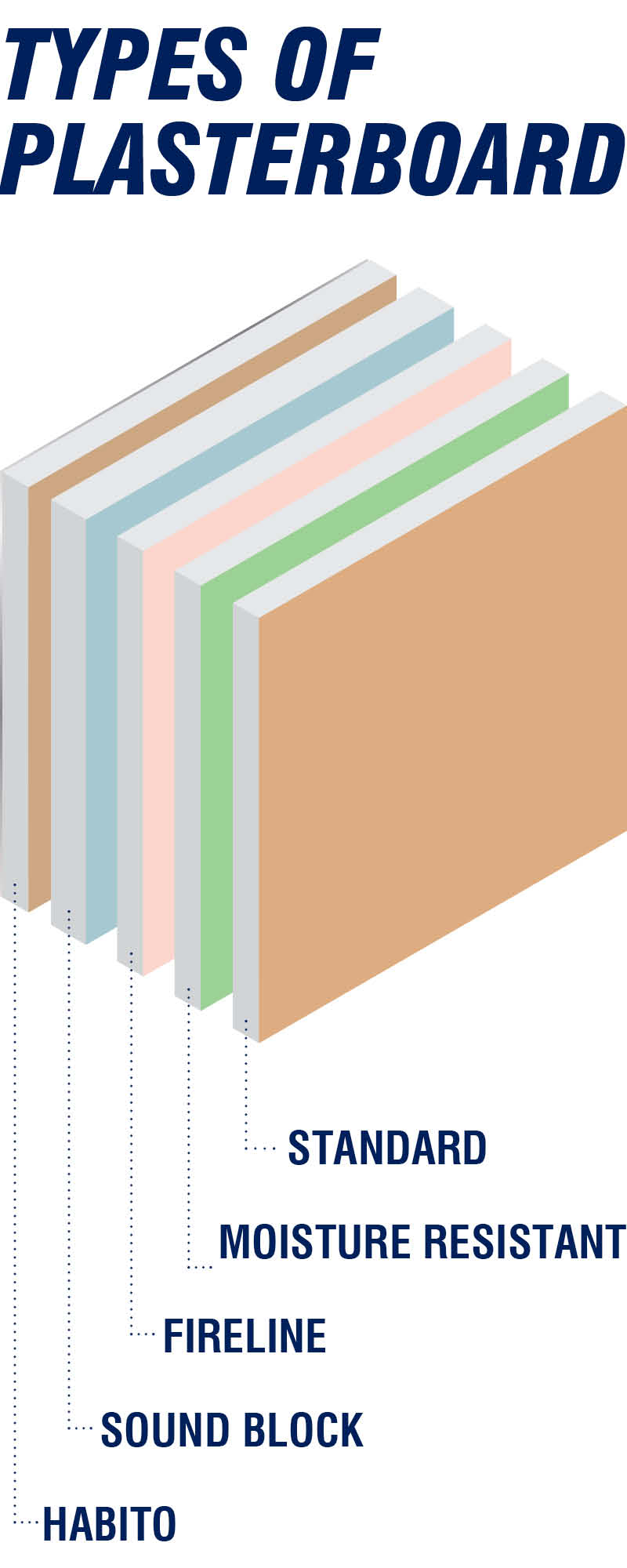
Here at Chadwicks, we supply several different types of plasterboard which are distinguished by colour. They are in different colours so that installers can quickly identify the right board when they are on site. They save time and help avoid costly mistakes.
When we think about the different colours if we break it down simply before we look at the benefits of each one.
Need to cope with humidity? Moisture Resistant (Green)
Need a quieter room? Soundbloc (Blue)
Need extras fire protection? Fireline (Pink)
Need to hang heavy items? Habito Board (Grey and White)
Moisture Resistant Plasterboard for Bathrooms and Kitchens
A moisture resistant plasterboard is green in colour. It is used in areas that would get occasional moisture and high levels of humidity like bathrooms, kitchens, utility and laundry rooms.
- It has a water-repellent core which means it has less mositure absorption and damage.
- It contains a special additive that helps reduce mould and mildew creating a healthier environment t and lower maintenance.
- it is resistant to humid conditions, so it maintains its strength and stability.
David mentioned in class, that we find a common false assumption that moisture resistant plasterboard is waterproof, but it is not, it helps resist mositure but in the case of a shower area that needs to be waterproofed an additional step of tanking must be applied.
Fireline Plasterboard Explained
A Fireline plasterboard Is pink in colour. This pink plasterboard is designed to enhance fire protection. David explains to us that they contain glass fibres and other additives within the gypsum core to help slow down the spread of fires. These would be used in areas like garages that are attached to houses, buildings where regulations are especially for fire rating. They would be installed in both walls and ceilings were required.
- It has glass fibre and heat resistant additives in the core which means it increases fire resistance and slows the spread of fire to protect the buildings structure.
- It maintains its integrity for longer when exposed to high temperatures, giving occupants more time to leave.
-
Fire rated system compatibility which helps meet fire safety and building regulation requirements.
Sound Block Plasterboard for Acoustic Properties.
If a customer comes in to build a new man cave, where they can roar at the telly in peace when watching sport we would always suggest the blue soundbloc plasterboard. This blue plasterboard is a higher density plasterboard to help with acoustic insulation. Ideal for home offices, schools, media and meeting rooms as well as bedrooms.
- It has a high intensity gypsum core which reduces noise transmission, creating a quieter environment.
- It has enhanced acoustic performance which improves privacy and comfort.
- It offers acoustic performance compatibility which helps reach building regulations.
As David points out it’s good to note that even though these boards are a sound block, it doesn’t mean they are soundproof. He did give us a great tradie tip to help with further acoustic properties we need by doubling up the board to make it harder for sound to pass through the board. It comes 15mm thick.
Habito Plasterboard
A Habito board is steel grey and has a brown reverse. Habito is the same thickness as a plasterboard but it is twice as dense. This allows for durability and strength. It allows heavy items to be fixed directly to the wall without the need for special fixings. It is perfect for kitchen cabinets because gravity never takes a day off and for shelving, TV mounting, mirrors
- It has a high strength gypsum core which helps with allows you to hang heavy items such as a TVs, shelves, radiators, kitchen units directly into the wall without the need to special fixings.
- It has exceptional impact resistance which allows for knocks, bumps and everyday wear which makes it ideal for places like schools and busy commercial environments.
- It has a high pull out for screws and fixings, which allows items to be securley mounted directly onto the board.
David explains in the class that a single wood screw can hold up to 15kg, which gives us a great indication on how useful and easy this would be to hang shelves and even kitchen cabinets if used in our homes.
Need Help Choosing?
If you are ever in doubt of which plasterboard you need for a certain project call into one of our stores and you can go through your options with our trade advisors in store in our Chadwicks branches
Branch Locator: https://www.chadwicks.ie/stores/
Watch the full episode here:
You can follow along with the YouTube Series here, make sure to like and subscribe to be notified on the next episode
FAQ's
What thickness plasterboard should I use?
The thickness of the plasterboard depends on what room, wall type and performance you need. 12.5mm is the standard board for general walls and ceilings. 12.5mm-15mm is for sound block and is denser and used for bedrooms and media rooms. Fireline is 12.5mm -15mm depending in requirement and protection.
What plasterboard should I use behind a stove?
Standard plasterboard is not recommended for walls directly behind a stove, it isn’t designed to withstand high temperatures. For the walls behind a stove that would be exposed to high temperatures, a cement board is commonly used. Always follow manufacturer guidelines to ensure compliance with building regulation.
Can I use a standard plasterboard in a bathroom?
Standard plasterboard can be used only in areas where there won’t be direct moisture and direct water contact. It can be use on areas that are away from showers, baths sink etc and can be used on the ceiling in a well-ventilated bathroom. With bathrooms being in a natural humid environment, problems that may be faced with excessive moisture the plasterboards can swell of even encourage mould growth. The plasterboard for bathrooms is moisture resistant plasterboard (green in colour) This is generally a better choice.
What side of plasterboard faces out?
The side of the plasterboard with the writing side should be facing out.
Can plasterboard be recycled?
Most types of plasterboard can be recycled, but when it has other materials like adhesive, tiles or other materials it can be more difficult. It needs to be kept separate from other general construction waste. Always check with your local authority to find out how to properly dispose it in your area.
Check here for more information and to search your area Plasterboard - My Waste
Disclaimer: The information in this article is intended for general guidance on common plasterboard types and their typical uses. Product specifications, building regulations, and installation requirements can vary by manufacturer and location. Always check the relevant local building codes and consult a qualified professional or supplier before selecting or installing any plasterboard product. The author accepts no responsibility for any loss, damage, or issues arising from the use of this information.